
A study published on 28 October 2026 says AI tools are leaning less on journalism than they were five months ago. If you have been told that “getting press” is the route to being recommended by ChatGPT or Gemini, it is worth knowing what the numbers actually say, and what they do not.
What the new AI citations study found
Muck Rack, a PR software company, publishes a regular report called “What Is AI Reading?”. The October 2026 edition draws on more than 40 million AI responses and 207 million citations from January to September 2026. A fresh September collection ran 1,020 unbranded consumer prompts across ChatGPT, Claude, Gemini and Perplexity.
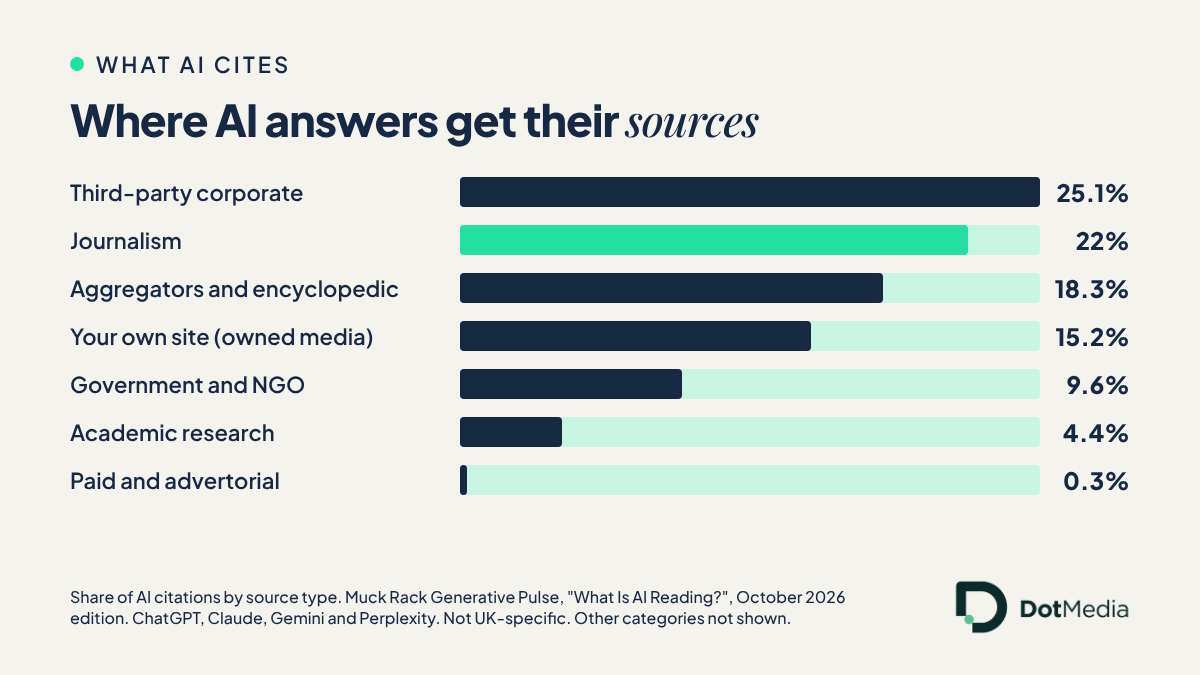
Two headlines came out of it. First, more than 84% of citations came from what Muck Rack calls earned and third-party sources. Second, journalism’s share of citations fell from 27% in May to 22%, with ChatGPT driving most of the drop, according to the same release. Unite.AI’s coverage of the report is clear that this is a change in share, not proof that fewer news links are being cited in absolute terms.
One more detail matters for any business thinking about paid placements: paid and advertorial content made up just 0.3% of citations.
The numbers at a glance
| Source type | Share in May 2026 | Latest share (Sept 2026) |
|---|---|---|
| Journalism | 27% | 22% |
| Third-party corporate content | 24% | 25.1% |
| Owned media (a brand’s own site) | 13.7% | 15.2% |
| Paid and advertorial | 0.3% | 0.3% |
Source: Muck Rack Generative Pulse, “What Is AI Reading?”, October 2026 edition. This is a vendor study of ChatGPT, Claude, Gemini and Perplexity. It is not UK-specific, and the release contains no UK breakdown.
Read the headline carefully
The 84% figure sounds like a green light for PR. It deserves a pause. In August, David Clare of PR agency Fire on the Hill argued in PR Daily that the number uses a very broad definition of “earned”. It lumps journalism together with academic research, government sources, Wikipedia, social platforms and third-party corporate content. His critique was of an earlier edition, but the same category approach appears to apply here.
That matters because most business owners hear “earned media” and think newspapers and trade titles. On Muck Rack’s own latest numbers, journalism is about a fifth of citations. Useful, but not the whole picture.
We have not run our own citation study, so we are relying on Muck Rack’s data and its limits. It is also a company that sells PR software, so read it with that in mind.
What this means for a UK small business
Press coverage still helps, but it is one source among several
If a trade title or regional paper writes about you, that can still be picked up by AI tools. It is just not the only door. Third-party content such as industry directories, partner pages, and detailed reviews on other sites carried a larger share (25.1%) than journalism in this study.
Your own website is gaining ground
Owned media rose from 13.7% to 15.2%. That is a modest move, but it points the right way for businesses that publish clear, specific pages about what they do. If you have not looked at how your site reads to an AI tool, our piece on whether your online shop is ready to be recommended is a good place to start.
Do not pay for it
At 0.3%, paid and advertorial content barely registers as a cited source. That does not cover ads themselves, which are a separate matter. We covered what is changing there in our post on Google bringing ads to AI Mode.
A practical checklist for this month
Check the pages that describe your services are clear and factual. Make sure your business details match across directories and partner sites. Ask satisfied customers and partners to write specifically about what you did for them. Then, if you are pursuing press, aim for titles your customers actually read rather than whatever is easiest to get into.
Conclusion
Journalism’s share of AI citations fell from 27% to 22% in Muck Rack’s data, and the wider point holds: AI tools draw on a mix of sources, and your own site and third-party mentions sit alongside the press. The figures come from a vendor, cover four AI tools, and are not UK-specific, so treat them as a direction rather than a rule. Our advice is simple: be easy to find, easy to understand, and mentioned accurately in more than one place.
FAQ
What is an AI citation?
It is a link or source that an AI tool such as ChatGPT or Gemini shows or uses when it answers a question. Studies like Muck Rack’s count which types of websites those citations come from.
Did journalism really fall out of AI answers?
No. The report says journalism’s share of citations fell from 27% to 22%. That is a share, not a measure of how many news links are cited, and providers changed models during the study period.
Is this data about the UK?
No. The release contains no UK-specific data, so we cannot say how UK searchers or UK publishers compare.
Should a small business invest in PR for AI visibility?
Coverage in titles your customers trust is still worthwhile, but this data suggests it should sit alongside a strong website and consistent mentions on other sites, not replace them.
Ready to chat? Book a free 15-minute call and we’ll look at how your business currently shows up in AI answers and what to fix first.