
On 28 October 2026, McKinsey published new evidence on agentic commerce, based on its Agentic Commerce Consumer Survey. The Retail Technology Innovation Hub reported it the same day under a blunt headline: retailers are losing the start of the shopping journey to AI tools.
Before anyone panics about AI shopping, let’s look at what the numbers actually say, because the details are more useful than the headline.
What the survey measured
McKinsey surveyed about 21,000 consumers across 11 markets, including the UK, with fieldwork in June 2026. Base sizes vary by question. McKinsey defines “AI users” as people who used an AI chat or search tool, a retailer’s AI assistant, or both, for shopping in the past three months.
The article we read does not break out UK-specific results, so the figures below are averages across all 11 markets. They are not UK numbers, and we would not present them as such.
The numbers that matter
| Measure | Figure |
|---|---|
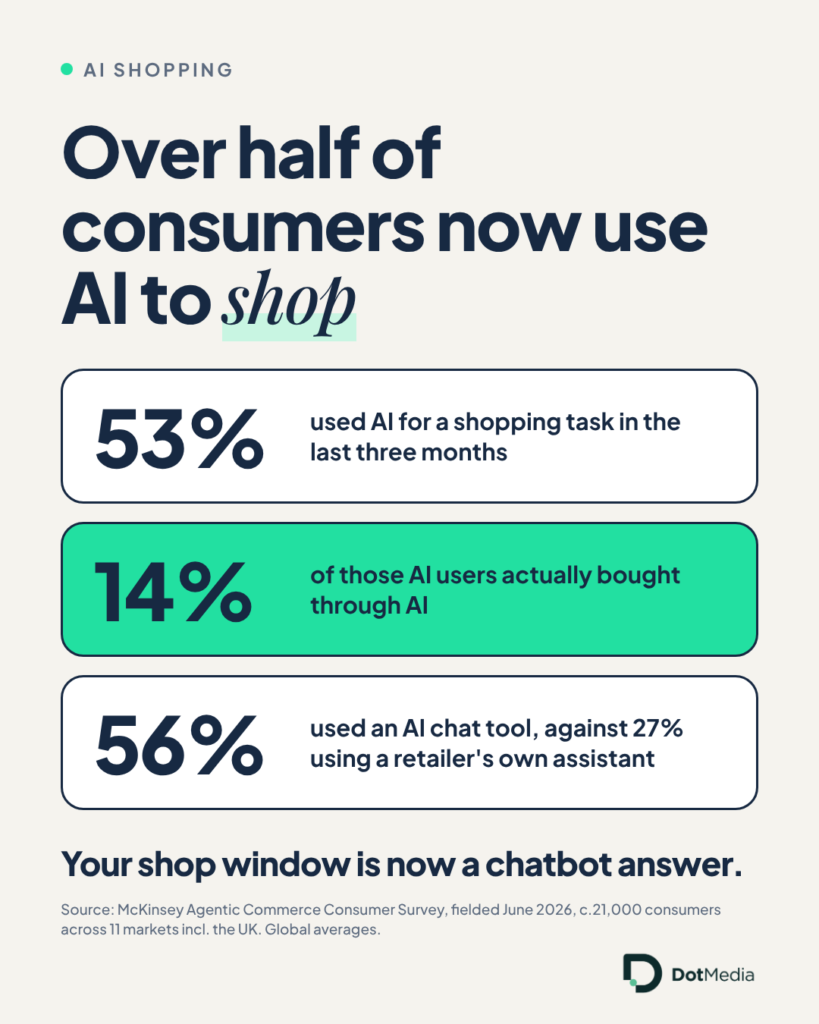
| Consumers who used AI for a shopping task in the past three months (11-market average) | 53% |
| AI users who completed a purchase through AI (global) | 14% |
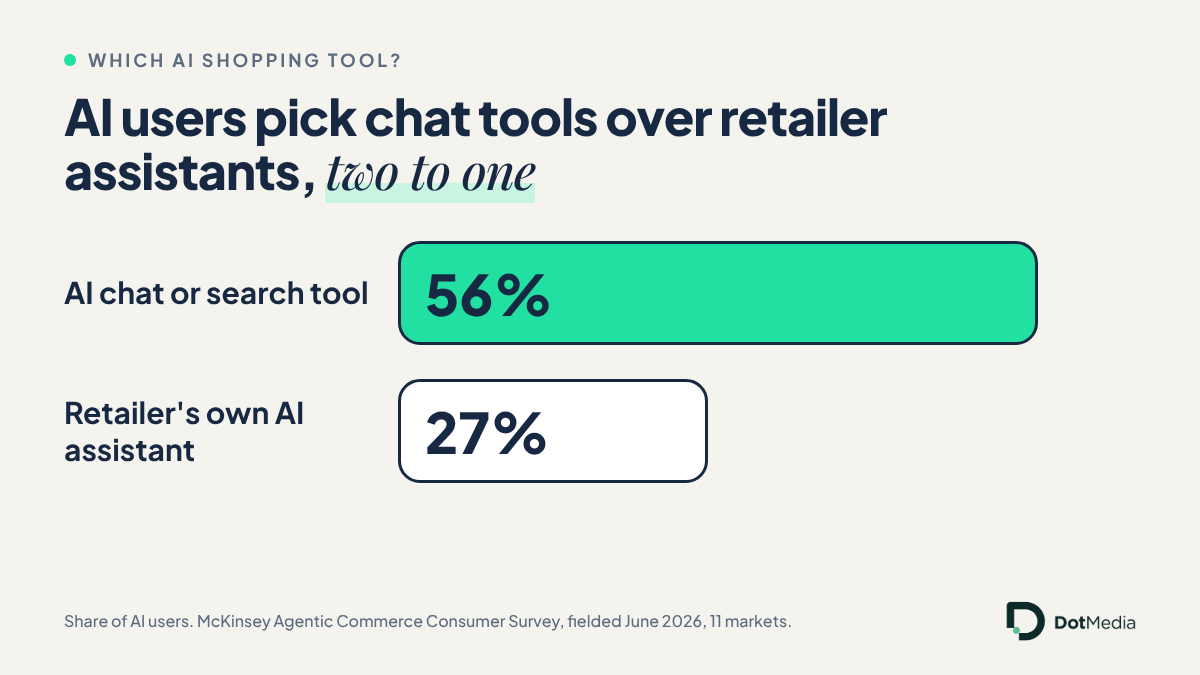
| AI users who used an AI chat or search tool | 56% |
| AI users who used a retailer’s own AI assistant | 27% |
| Completed purchases via retailer assistants vs AI chat tools | 15% vs 14% |
In the US, McKinsey reports that the share of AI users completing a purchase through AI rose from 10% to 17%.
What this tells us
The headline is adoption. More than half of consumers in these markets are using AI somewhere in the shopping process. The detail is that most of that use is still research and inspiration, not checkout. Only 14% of AI users actually bought through AI.
So the opportunity, and the risk, sits earlier in the journey. If someone asks an AI tool what to buy, you are either in the answer or you are not.
Why this matters for a small UK retailer
Large retailers can build their own assistants. The survey shows those are used less than general AI chat tools (27% against 56%), and the two are roughly level at the point of purchase. A small shop is unlikely to build an assistant, so the realistic route is to make sure the general tools can find and describe you accurately.
What we would check
Start with your product pages. If a page is three lines and a stock photo, an AI tool has very little to work with. Write down what a customer would ask: who is it for, what is it made from, how long does delivery take, what is the returns policy, how does sizing run.
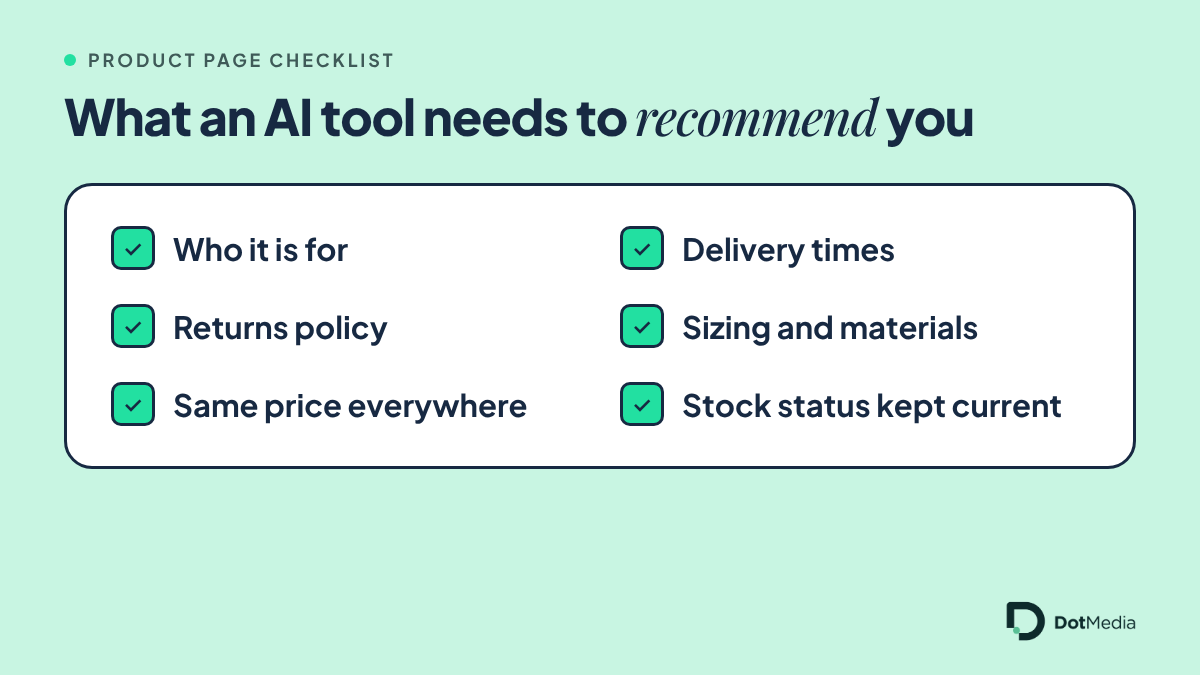
Then look at your structured data and product feeds. Price, availability and product details should be consistent everywhere they appear. An AI tool that finds two different prices for the same item will either guess or skip you.
Finally, ask the tools directly. Type the questions your customers would ask into a few AI assistants and see whether your shop turns up and whether what is said about you is right. If a chatbot describes your delivery times wrongly, that is your problem to fix, not the chatbot’s.
What we would not do
We would not rebuild a shop for “agentic commerce” on the strength of one survey. The 14% purchase figure is a reminder that most people still check out the traditional way. Good product information helps in both worlds, so it is a safe place to spend your effort.
Conclusion
McKinsey’s survey says AI is now a normal part of how people research what to buy. It does not say people have stopped visiting shops or websites, and it does not give UK-specific figures in the article we read.
What it does say is that the first step of the journey is moving, and a clear, accurate, well-described shop is the best preparation we know of.
FAQ
Does the 53% figure apply to the UK?
No. It is an average across 11 markets that includes the UK. The article we read did not give UK-only results.
How many people actually buy through AI?
McKinsey reports 14% of AI users globally had completed a purchase through AI. In the US, the figure rose from 10% to 17%.
Are retailers’ own AI assistants more popular than ChatGPT-style tools?
No. In the survey, 56% of AI users had used a general AI chat or search tool, against 27% who used a retailer’s assistant.
What should I fix first?
Product descriptions, delivery and returns information, and consistent prices and availability. They help human customers and AI tools alike.
Do I need to do anything technical?
Check your product feed and structured data are accurate. If you are unsure, an audit will show you quickly.
Ready to chat? Book a free 15-minute call and we’ll check how AI tools describe your shop today.