
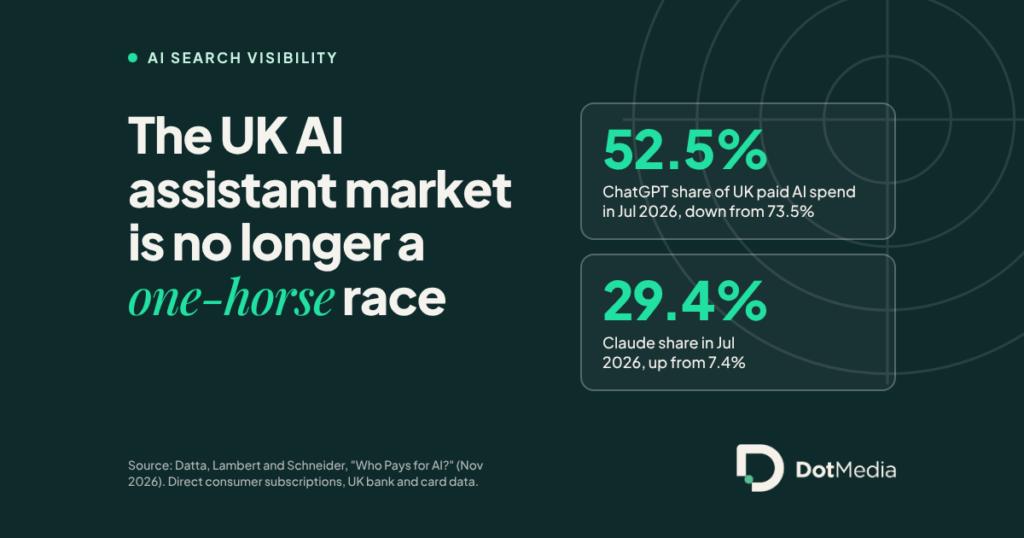
A new UK working paper out this week has put numbers on something many of us have felt for a while: the AI assistant market in Britain is no longer a one-horse race. If you are working on how your business shows up when customers ask AI for recommendations, that matters. Here is what the study found, what it does not tell us, and what we would do about it.
What the new UK study found
The paper, “Who Pays for AI?” (CAGE Working Paper No. 828), was written by Nikhil Datta and Peter John Lambert of the University of Warwick and Patrick Schneider of Imperial Business School. It uses de-identified bank and card records from around 14 million UK accounts, weighted to represent UK adults, with data running to July 2026. The Next Web reported it on 5 November 2026, and Eurasia Review followed on 6 November.
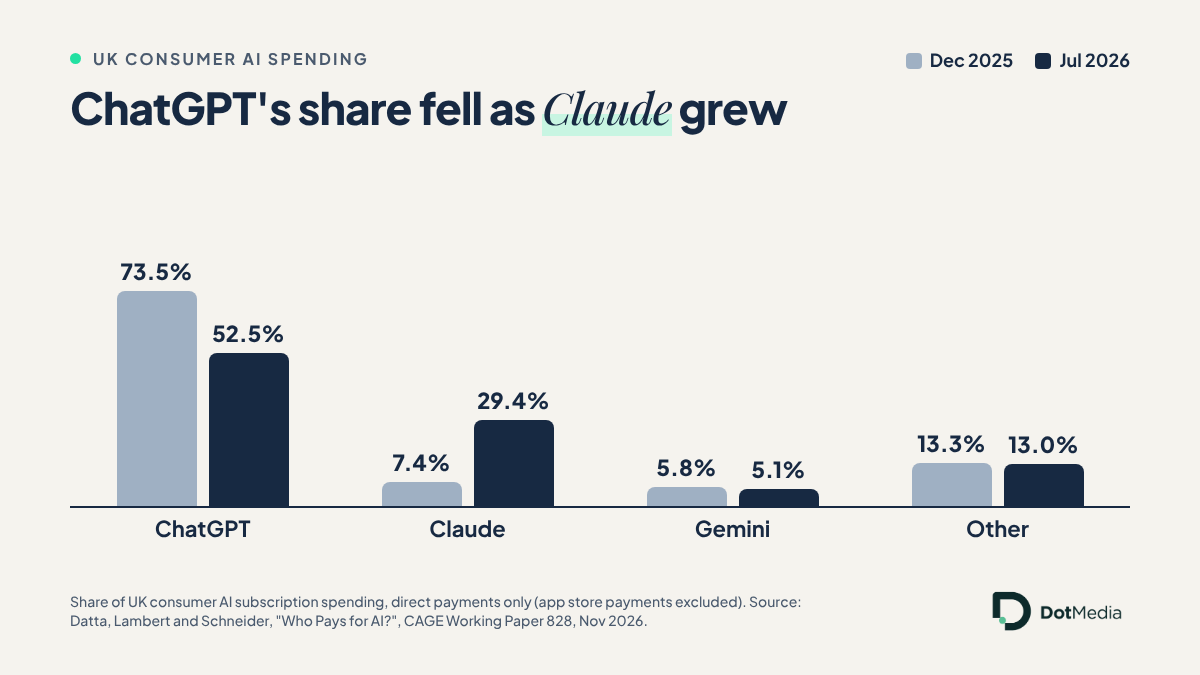
Two headline findings stand out. First, about 5.1% of UK adults (roughly 2.8 million people) were paying for an AI assistant out of their own pocket in June 2026. Second, the split of that spending has moved fast:
| Provider | Share of UK consumer AI subscription spending, Dec 2025 | Share, Jul 2026 |
|---|---|---|
| ChatGPT | 73.5% | 52.5% |
| Claude | 7.4% | 29.4% |
| Gemini | 5.8% | 5.1% |
| Other | 13.3% | 13.0% |
Source: Datta, Lambert and Schneider, “Who Pays for AI?” (whopaysfor.ai). Direct payments only; app store subscriptions are excluded from the provider split.
What the numbers do not tell us
This is easy to over-read, so a few honest caveats. The figures measure share of spending on personal subscriptions, not share of users or share of questions asked. Claude’s share is partly lifted by people paying for higher-priced plans. The study cannot see free use, or licences that an employer pays for, so it understates how many people use assistants at all. The authors also note that app store payments are estimated rather than observed, and that the £1.07 billion annual spend is an extrapolation from July’s monthly rate. It is a working paper, not a settled fact.
Why this matters if you want to be recommended by AI
Your customers are not all asking the same assistant
If more than one in four pounds of paid AI spending now goes to a second assistant, then “are we visible in ChatGPT?” is the wrong question on its own. The right one is whether a customer asking any major assistant for a supplier like you would find you, and get your details right.
We should be straight about the limits here. We do not have our own data on how often each assistant recommends UK small businesses, and the study does not measure that either. What it does show is that where your customers ask is spreading out. That is a reason to avoid tuning everything to one platform.
The picture varies by place and person
Per Eurasia Review’s summary, paid use was 7.9% of adults in London in June 2026, against 5.1% nationally and 3.8% in the North East. If your customers are in London or are professionals who use these tools at work, assume a higher share of them are already asking an assistant before they ever search.
What we would do this week
1. Ask the questions your customers ask, in more than one assistant
Write down ten questions a buyer might type, such as “best [your service] in [your area]” or “who can help with [your problem]”. Put them into ChatGPT, Claude and Gemini. Note whether you appear, who does, and whether the details about you are right. It takes an hour and it is the most useful baseline you can get for free.
2. Make your facts consistent and easy to read
Assistants build answers from what they can find and trust. Make sure what you do, where you work and who you serve is stated plainly on your site, and that it matches your Google Business Profile and any directory listings. Clear service pages beat clever copy.
3. Earn mentions that are not on your own site
Third-party coverage tends to carry more weight than a business describing itself. We covered a related shift recently in our look at AI citing less journalism, and if you sell online, our post on AI shopping and recommendations covers what to check on your product pages.
4. Do not over-rotate
Only around one in twenty UK adults pays for an assistant, and this is one study with stated limitations. Treat it as a prompt to widen your checks, not a reason to rebuild your marketing.
Conclusion
The takeaway is simple. The UK AI assistant market is shifting quickly, and customers are spreading across more than one tool. Check how you appear in several of them, keep your facts consistent, and build credible mentions beyond your own website. That work pays off whichever assistant wins the next seven months.
FAQ
Which AI assistant is most used in the UK?
This study measures paid subscription spending, not total use. On that measure ChatGPT still led in July 2026 with 52.5%, with Claude on 29.4%. Free use is not captured, so it is not a full picture of usage.
How many UK adults pay for an AI assistant?
The study estimates 5.1% of UK adults, around 2.8 million people, in June 2026, up from 2.3% a year earlier according to The Next Web’s report.
Do I need to optimise for each AI assistant separately?
Not separately. Clear, consistent information about your business and credible third-party mentions help across the board. What changes is where you test, so check more than one assistant.
Is this data specific to the UK?
Yes. It is based on UK bank and card records, weighted to represent UK adults. It covers personal subscriptions only, not business or employer-paid accounts.
Ready to chat? Book a free 15-minute call and we’ll check how your business shows up across the AI assistants your customers use.