
If you have been watching ChatGPT Ads from the sidelines, a change landing on Monday is worth five minutes of your time. OpenAI is swapping its hard-ceiling bid options for average-based targets, and the old ones switch off in the new year.
What OpenAI has changed
On 5 November 2026, OpenAI emailed ChatGPT Ads advertisers about its bidding options. Search Engine Roundtable published the details that day, and Relevant Audience covered the same email. This post is based on those published reports, not on our own campaign results.
The dates that matter
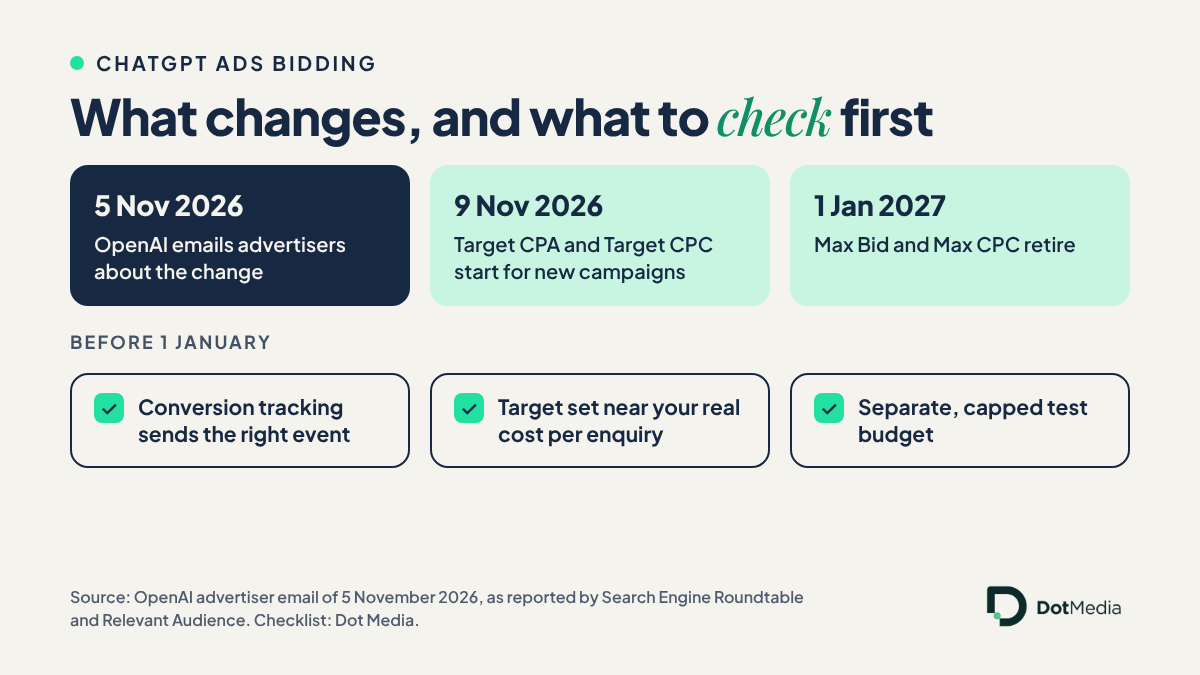
| Date | What happens |
|---|---|
| 5 November 2026 | OpenAI emails advertisers about the change |
| 9 November 2026 | Target CPA replaces Max Bid for new conversion campaigns. Target CPC replaces Max CPC for new click campaigns |
| 1 January 2027 | Max Bid and Max CPC retire. Remaining campaigns move to Target CPA or Target CPC |
Existing campaigns keep running on their current setting until you switch them or the deadline arrives. The autobid option called “Maximize results” has also been renamed “intelligent bidding”.
A target is not a cap
This is the part to understand. A cap says “never pay more than this for one click”. A target says “aim for this on average”. OpenAI’s email says Target CPC “lets our system bid above or below your target in each auction”. Any single click or conversion can cost more than the figure you set, and the average is what the system works towards.
OpenAI also warns that “restrictive targets or weak conversion signals can reduce ad delivery and leave budget unspent”. In plain English: set the target too low, or give the system poor tracking, and your ads may barely run.
Does this apply to UK businesses?
Probably, but check your own account. ChatGPT Ads went live in the UK on 6 June 2026 and, according to Digiday, the self-serve Ads Manager beta reached UK advertisers on 19 June. UK agency Adtrak reports the same timeline and notes the ads only appear to logged-in adults on the Free and Go tiers.
What we cannot confirm: neither report on the 5 November email mentions the UK, and in June Digiday said it could not confirm cost-per-action bidding for UK advertisers. So treat the dates above as the global timetable and look at what your Ads Manager actually offers on Monday.
What we would check before 1 January
1. Your conversion tracking
Target CPA only works if the system can see what a conversion is. OpenAI tells advertisers to confirm the Pixel or Conversions API is sending the right event and to act on any Event Quality Score warnings. For most small businesses that means a tracked enquiry form or booked call, not just a page view. Adtrak makes the same point and suggests linking clicks to CRM records so you judge lead quality, not only lead volume.
2. A target based on real numbers
Work out what an enquiry actually costs you today. As an illustration, if you spent £400 and got 10 enquiries, your cost per enquiry is £40. Start your target near that figure. A target far below it is the “restrictive target” OpenAI warns about.
3. A separate, capped test budget
Because you lose the per-bid ceiling, protect yourself with a daily budget you are comfortable losing. Adtrak suggests funding tests from a separate pot rather than cutting Google Search, and allowing at least 60 days before judging the result. It also notes there are no public benchmarks yet for UK click costs, conversion rates or lead quality, so nobody can honestly promise you a result.
Should a small business be buying these ads at all?
Not necessarily, and not urgently. The ads sit beneath ChatGPT’s answers rather than inside them, and they are only shown to Free and Go users. If you are still working out where AI tools send customers, you may get more from being recommended in the answer than from paying to sit next to it. We covered that in our look at how AI citations are changing, and in our post on ads arriving in Google’s AI Mode.
If you do want to test, the change makes one thing clearer: this is becoming a conventional automated-bidding channel. The businesses that do well on those channels are the ones with clean tracking and realistic targets, not the ones with the biggest budgets.
Conclusion
From 9 November, new ChatGPT Ads campaigns bid towards an average target instead of a hard ceiling, and the old options retire on 1 January 2027. If you already run campaigns, review them now. If you are only curious, fix your tracking first and treat any test as an experiment with a fixed budget. Either way, check what your own Ads Manager shows, because the reporting so far does not spell out the UK position.
FAQ
When do ChatGPT Ads switch to Target CPA and Target CPC?
New campaigns can use them from 9 November 2026. Max Bid and Max CPC retire on 1 January 2027, and remaining campaigns move across automatically.
Are ChatGPT Ads available in the UK?
Ads went live in the UK on 6 June 2026, and Digiday reported the self-serve beta reaching UK advertisers on 19 June. Only logged-in adults on the Free and Go tiers see them.
What is the difference between a bid cap and a target?
A cap limits what you pay for any single click. A target is an average the system aims for, so individual clicks can cost more or less than it.
Will my existing ChatGPT Ads campaigns stop working?
Not on 9 November. They keep their current strategy until you switch them or until 1 January 2027, when they move to the new targets.
Ready to chat? Book a free 15-minute call and we’ll talk through whether ChatGPT Ads belong in your marketing mix, or whether your budget should go elsewhere first.