
“Will AI replace SEO?” is one of those questions that arrives with a confident answer attached, usually from someone selling something. Half the internet says SEO is dead, and the other half says nothing has changed at all.
The short answer is no, AI is not replacing SEO, but it is changing where the work happens and what counts as success. Google itself says optimising for its generative AI features is still SEO. What has shifted is how many people click through, and how much of your visibility now depends on what other sites say about you.
Here is what the evidence shows, where it falls short, and what we would do about it. Much of the research below is American, and we will say so each time.
Will AI replace SEO? The short answer
Google’s own guidance, “Optimizing your website for generative AI features on Google Search”, states that “optimizing for generative AI search is optimizing for the search experience, and thus still SEO”. The page was last updated on 10 July 2026, and Search Engine Journal reported the same line when the guide launched in May 2026. You can read the original on Google Search Central.
That is Google describing its own products, so treat it as one side of the story. It does not cover ChatGPT, Claude, Perplexity or other assistants, which have their own ways of choosing what to mention. We cover that split in our guide to how GEO, AEO and SEO relate.
The practical reading is simple. The foundations of SEO still matter, because AI features draw on the same pages and quality signals. The label on the work matters much less than whether the work gets done.
How AI is changing SEO
Fewer clicks when an AI answer appears
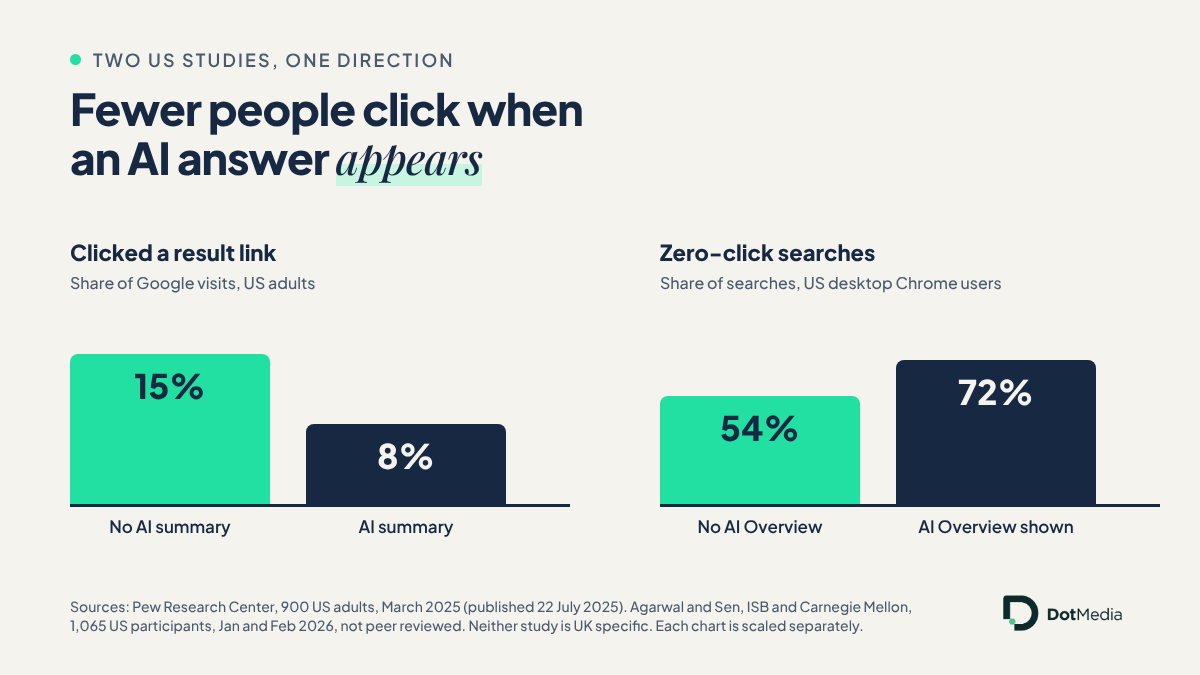
The clearest change is in clicks. When a search results page includes an AI-written summary, fewer people go on to visit a website. Three separate studies point the same way, though none of them is UK-specific and they measure different things.
| Study | What it measured | Finding | Where and when |
|---|---|---|---|
| Pew Research Center | Share of Google visits where the person clicked a traditional result link | 8% with an AI summary, 15% without | 900 US adults, browsing data for March 2025 |
| Agarwal and Sen, ISB and Carnegie Mellon (reported by Search Engine Journal) | Outbound clicks on queries that triggered an AI Overview | Down 38%, and zero-click searches rose from 54% to 72% | 1,065 US desktop Chrome users, January and February 2026, not peer reviewed |
| Seer Interactive | Organic click-through rate across client queries | 1.31% with an AI Overview shown, 3.16% without | 53 brands, country not stated, December 2025 |
Read these as direction rather than a forecast for your business. Pew is a survey panel of US adults, the university study is a working paper that has not been peer reviewed, and Seer says its own data shows correlation, not cause. We have not found a comparable UK figure, and we covered Google’s inability to show UK sites their own numbers in our look at AI Overviews click data.
Visibility now depends on more than your own site
When an assistant writes an answer, it tends to draw on what other sources say about a business, not just the business’s own pages. That is why the part of the work we think is growing is the part that happens away from your website: reviews, coverage, mentions and links from places the assistants trust.
We do not have original evidence of our own on how much weight each assistant gives to each kind of source, so we will not invent a figure. What we can say is that earning genuine third-party coverage helps both traditional links and the pool of sources an assistant can cite. If you want the background, our plain guide to digital PR explains how that works, and our AI visibility page covers how we look at it.
AI tools are taking over the routine work
The other change is on the supplier side. Drafting, summarising, tagging and reporting are quicker with AI tools than they were two years ago. That makes the routine parts of SEO cheaper, and it makes weak, generic content cheaper to produce too.
Google’s guide is blunt about where this goes wrong. It asks for original content with first-hand or expert experience rather than a restatement of what is already out there. Producing more pages that say what every other page says is a cheaper way to be ignored.
What AI is not replacing
The technical basics
For a page to appear in Google’s AI features, Google says it needs to be indexed and eligible for Search, crawlable, and performing well. That is ordinary technical SEO. A site that search engines cannot read properly will struggle to be cited by anyone, so this is where we would check first.
Content that is actually yours
Assistants and search engines can both summarise the common answer to a question, so the common answer is rarely a reason to visit you. What earns a click, or a citation, is something a summary cannot supply: your own pricing logic, your own data, your own view on a decision, a clear answer from someone who does the work.
The shortcuts
Google’s guide also says you can ignore a number of tactics sold as AI search secrets. Specifically, it says you do not need to create llms.txt files, chop content into small pieces for AI, rewrite pages just for AI, or add special structured data for generative AI search. Structured data is still worth having for other reasons, but Google says it is not required here. That is Google’s view of its own products, and we have not seen equivalent official statements from the other assistants, so we would not pay for these as extras before the basics are sound.
Will AI replace SEO jobs and agencies?
We are an agency, so weigh this accordingly. We do not think anyone can predict it with confidence, and we have no data on UK job numbers to point to.
What we can see is the direction of the work. The routine parts, such as first drafts, meta descriptions and basic reporting, are getting cheaper and faster. The parts that are harder to automate are deciding what is worth publishing, getting a business mentioned by sources that matter, and judging whether a recommendation fits a particular company. A supplier who only sells the routine parts has more to worry about than one who advises on the rest.
If you are hiring help, ask what they do that an AI tool alone could not, and ask how they check that what they publish is accurate.
What we would do about it
None of this needs a new strategy. It needs a few checks, in a sensible order.
First, make sure the foundations are sound: your key pages are indexed, load properly and answer the questions your customers actually ask. Second, look at your own numbers. Google’s guide points site owners to Search Console’s reporting on its generative AI features, and your own analytics will show whether clicks on your important queries have moved. Third, ask a few assistants the questions your customers would ask, and see whether your business is mentioned, and what they say. That is a spot check, not a measurement, because answers vary from one asking to the next.
Finally, put effort into being worth mentioning. Genuine coverage, honest reviews and content that has your own experience in it do more than a clever format.
Conclusion
AI is not replacing SEO, but it is moving the goalposts. Fewer people click when an AI answer appears, at least in the US studies we have, and being named in the answer is starting to matter alongside ranking beneath it. The foundations Google asks for, and the reputation that exists beyond your own pages, are what carry across both.
Be wary of anyone selling a single secret fix, and be wary of precise figures that are not clear about what they measure. Check your own data, fix the basics and keep a close eye on how your business is described.
FAQ
Will AI replace SEO?
No. Google says optimising for its generative AI features is still SEO, and the groundwork of crawlable, useful pages applies either way. What is changing is how many people click through and how much your visibility depends on other sites mentioning you.
How is AI changing SEO?
Mostly in three ways: AI summaries reduce clicks in the US studies we have found, visibility increasingly depends on mentions beyond your own site, and AI tools make routine tasks cheaper. We have not found UK click data to confirm the first point for UK sites.
Will AI replace SEO jobs?
We cannot predict that, and we have no UK job data to offer. Routine tasks are getting automated, while strategy, judgement and earning genuine third-party coverage are harder to hand to a tool.
Do I still need SEO if people use ChatGPT?
Yes, because most of the groundwork is shared, and Google remains a place customers search. We do not have UK figures on how many of your customers use assistants to find suppliers, so ask your own customers and check your analytics before shifting budget.
Ready to chat? Book a free 15-minute call and we’ll look at how your business shows up in search and in AI answers today, and which fixes are worth making first.