
If you have read anything about search this year, you will have met three acronyms: SEO, GEO and AEO. Each one comes with a confident claim that it is the thing your business must now invest in, usually followed by a pitch.
The short answer is that SEO is the foundation, and generative engine optimisation (GEO) and answer engine optimisation (AEO) are labels for extra work on being found and cited inside AI answers. Google says optimising for its own AI features is still SEO. Where the newer labels point at something real is largely away from your website, in whether other sites talk about you.
Here is what each term means, where they overlap, and what we would actually do about it. We will also be clear about what we know and what we do not.
AEO vs GEO vs SEO: what each term actually means
All three describe the same broad job, which is making your business easy to find and easy to recommend. They differ in where the finding happens.
SEO: ranking in search results
Search engine optimisation is the long-established work of helping your pages rank in a search engine’s list of results. It covers the technical health of your site, the content on it, and the links and mentions that point to it. When people talk about “AI SEO” they usually mean SEO that has been adjusted for AI features, or SEO done with AI tools, so check which one a supplier means.
GEO: being cited in generated answers
Generative engine optimisation is the effort to appear in answers written by AI systems such as ChatGPT, Google’s AI Mode and Perplexity. The term appears in an academic paper first posted in 2023, GEO: Generative Engine Optimization, presented at the KDD 2024 conference. Its abstract says the researchers’ methods can boost visibility “by up to 40%” in generative engine responses.
That is an upper bound from the researchers’ own testing, not a typical result, and it is not a measure of what would happen to a UK small business. We would not plan around it.
AEO: being the answer
Answer engine optimisation (AEO) has been used for a while to mean structuring content so that it can be lifted out as a direct answer, whether in a featured snippet, a voice assistant or, more recently, an AI summary. It is the older idea, and the one that overlaps most with ordinary good SEO writing: clear questions, clear answers.
One UK-specific warning. Searched on its own, “AEO” also means Authorised Economic Operator, a customs status run by HMRC for businesses involved in international trade (see the gov.uk guidance). So we always write “answer engine optimisation (AEO)” in full, and you may want to be careful when you search for it too.
How the three compare
| Term | What it is aiming for | Where the result shows up | How you would know it is working |
|---|---|---|---|
| SEO | Pages that rank and earn clicks | Search results pages | Rankings, clicks and enquiries from search |
| AEO | Content that can be quoted as the direct answer | Featured snippets, voice answers, AI summaries | Snippet ownership and answer appearances |
| GEO | Being mentioned and cited in AI-written answers | ChatGPT, AI Mode, Perplexity and similar | Whether you are named when people ask relevant questions |
Notice how much of the right-hand column depends on the same thing: a clear, trustworthy site that other people refer to.
Is GEO just SEO with a new name?
For Google, mostly yes, and Google says so itself. Its guide to optimising for generative AI features on Google Search (last updated 10 July 2026) states: “From Google Search’s perspective, optimizing for generative AI search is optimizing for the search experience, and thus still SEO.”
The same guide says you do not need to write in a specific way just for generative AI search, and that you do not need new machine-readable files, AI text files or special markup to appear in Google Search. It lists “AEO/GEO hacks” among the tactics to ignore. Its separate page on AI features and your website says there are “no additional requirements to appear in AI Overviews or AI Mode, nor other special optimizations necessary”, and that pages need to be indexed and eligible to be shown with a snippet.
There is a limit to how far that helps. It is Google describing Google. We have not found an equivalent official guide from OpenAI or Perplexity, so for ChatGPT and the others the evidence is thinner, and anyone claiming certainty about how they choose what to cite is guessing. We have no original study of our own to offer on this, and we would rather say so than dress up opinion as data.
What actually helps you appear in AI answers
Strip away the labels and the work is fairly consistent across all three. This is our judgement, built on Google’s published guidance and on what we do for clients, rather than a proven recipe.
Make sure the basics are sound
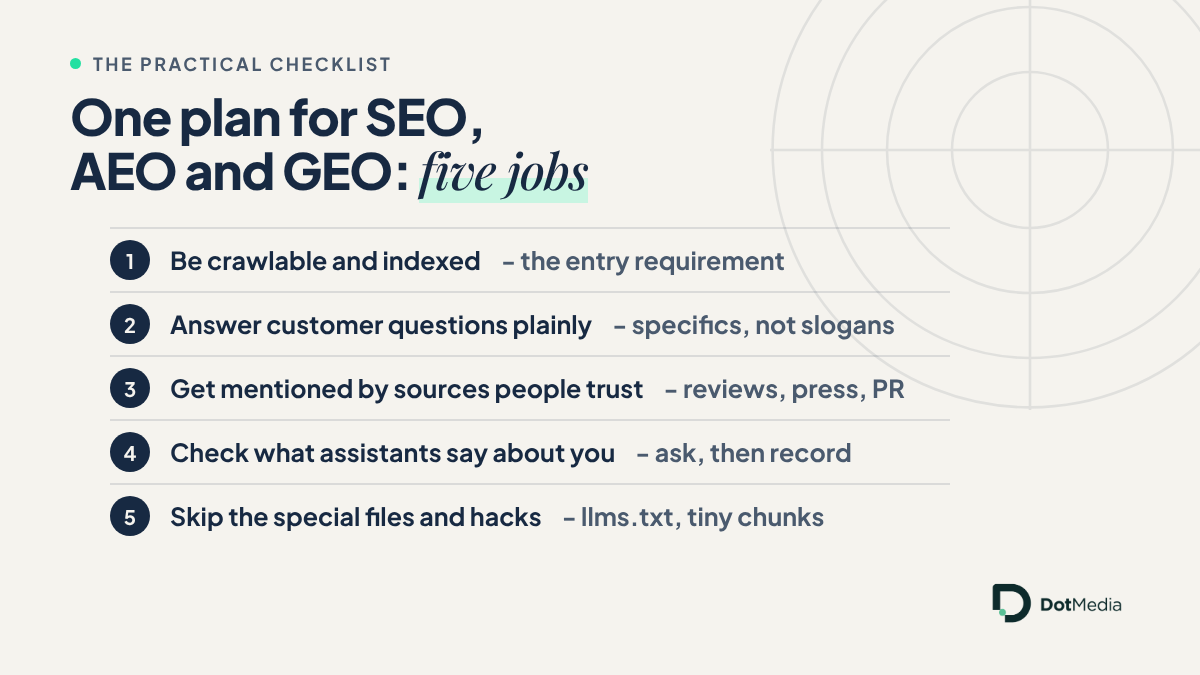
If a page cannot be crawled or indexed, it cannot be shown with a snippet, and Google says that is the entry requirement for its AI features. Fix that before anything else. Our AI visibility work starts here for the same reason.
Say plainly what you do, who for, and where
AI systems answer questions, so pages that answer questions clearly, in ordinary language, with real specifics, are easier to quote. That includes your services, your prices where you can share them, and the problems you solve. Vague brand language gives an assistant nothing to repeat.
Get talked about by sources other people trust
This is where GEO and AEO earn their keep as ideas. An assistant forming a view of your business draws on what is said about you away from your own website: reviews, trade press, directories, interviews and news coverage. That is the same territory as digital PR, which we explain in our plain UK guide to digital PR, and it is why we wrote about what a fall in journalism citations means for your business.
Check what is being said, rather than assume
Ask the questions your customers ask, in the assistants they use, and write down whether you are named and what is said. Platforms are starting to offer their own reporting, such as OpenAI’s Business Hub beta, though when we wrote about it we could not confirm it was available to UK businesses. Treat any single dashboard as a partial view.
What you can safely ignore
Google’s guide is unusually direct on this. For Google Search it says structured data is not required for generative AI search, that there is no requirement to break content into tiny pieces, and that new files such as llms.txt will “neither harm nor help” your visibility or rankings. Structured data is still worth using where it makes you eligible for ordinary rich results, so do not strip it out.
It is worth being sceptical of anyone selling a “GEO package” built around those items. Some of it may be harmless, but it is unlikely to be where the gains are.
Do you need all three?
You need one plan, not three budgets. In practice we would order it like this:
- Get the SEO foundations right, because everything else sits on top of them.
- Write your key pages so a person, or an assistant, can lift a clear answer from them.
- Build the third-party coverage that makes you a credible name to mention.
- Track whether you are being named, and adjust.
If your SEO is weak, buying extra AI-specific work first is putting the roof on before the walls. If your SEO is solid and nobody outside your own site mentions you, that is usually the gap worth closing next.
Conclusion
AEO, GEO and SEO are not three rival disciplines. SEO is the base, AEO is about being the quotable answer, and GEO is about being named in AI-written responses, and most of the practical work behind all three is the same: a sound site, clear answers and a reputation that exists beyond your own pages.
Ignore anyone who tells you a single trick will do it, and be wary of precise-sounding numbers, including the “up to 40%” one above, because they rarely transfer to your situation. Fix the foundations, earn the mentions, and check what the assistants really say about you.
FAQ
What is the difference between GEO and SEO?
SEO aims to rank your pages in search results. GEO aims to get your business mentioned and cited in answers written by AI systems. They share most of their groundwork, and Google describes optimising for its generative AI features as still SEO.
What does AEO mean?
In marketing it stands for answer engine optimisation, the practice of making content easy to use as a direct answer. In UK business more widely it can also mean Authorised Economic Operator, an HMRC customs status, which is why we spell the marketing term out in full.
Do I need to write differently for AI search?
Google says you do not need to write in a specific way for its generative AI search. Clear, specific, honest answers to real customer questions are what we would aim for, whichever assistant is reading.
Does llms.txt help my business appear in AI answers?
Google says AI text files will neither harm nor help visibility in Google Search. We have not found official guidance from other assistants saying otherwise, so we would not spend time on it before the basics.
Ready to chat? Book a free 15-minute call and we’ll look at how your business shows up in search and in AI answers today, and which fixes are worth making first.