
If you have asked three people what digital PR is, you have probably had three different answers: link building, press releases, or “getting us in the papers”. All three are partly right and none is the whole picture. This guide explains what digital PR is in plain terms, how it differs from the things it gets confused with, why it has become more relevant now that people ask AI tools for recommendations, and how to judge a proposal before you spend anything.
What is digital PR?
Digital PR is the practice of earning coverage from online publishers, such as news sites, trade titles, newsletters and podcasts, by giving them something genuinely worth publishing. The coverage usually brings a mention of your brand and often a link to your site. The word that matters is “earning”: a journalist or editor chose to include you, and nobody paid for the slot.
That matches how the pages ranking for this search describe it, give or take some wording, and it is worth holding on to because the rest of this guide depends on it.
How digital PR differs from traditional PR
Traditional PR is about reputation and relationships with the press, and the success measure was often a cutting in a newspaper or magazine. Digital PR keeps the relationships and the story-first thinking, but it is built around online publications, so the result is also something a search engine or an AI tool can find, read and connect back to your business. A print feature can still be excellent for credibility, but it leaves much less of a trail on the open web.
How digital PR differs from link building and paid placements
Link building starts from the link and works backwards to a reason to ask for one. Digital PR starts from a story and treats any link as a by-product. Paid placements, where you pay a site to publish an article, sit in a different category altogether. They can be a legitimate form of advertising, but they are not earned coverage and the rules around them are quite different, as we cover below.
Why digital PR matters more now that people ask AI
When someone asks ChatGPT, Gemini or Google’s AI features for a recommendation, the answer is assembled from what the tools can find about brands across the web, not just from the brand’s own pages. That is where third-party coverage comes in.
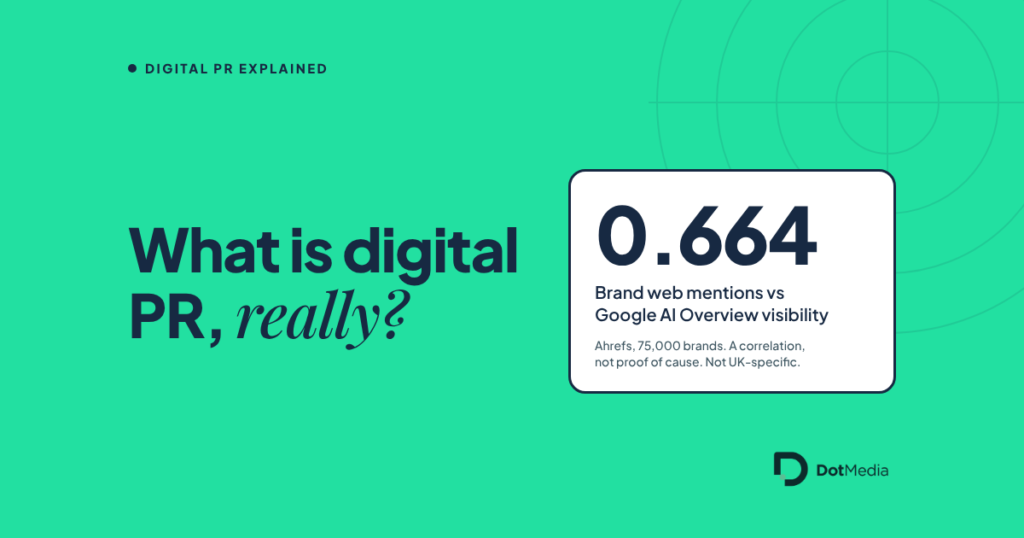
The best public evidence we have is an Ahrefs study of 75,000 brands, first published in May 2025 and last updated in April 2026. It compared several signals against how often each brand appeared in Google AI Overviews, using a rank correlation measure. Branded web mentions showed the strongest relationship, at 0.664, and Ahrefs reports that backlinks showed a noticeably weaker one. Go Fish Digital cites the same 0.664 figure for mentions.
It is worth being straight about what that does and does not tell you. It is a correlation, not proof that mentions cause AI visibility, and Ahrefs says so itself. The study was run by a company that sells the tools used to collect the data, it only covers brands with an established domain and search demand, and it measures Google AI Overviews only. It is not UK-specific and says nothing about ChatGPT. We would treat it as a good reason to take third-party mentions seriously, not as a guarantee of anything.
If you want the wider picture of what AI tools actually cite, we looked at it in our post on AI citing less journalism, including why the headline numbers need careful reading.
Digital PR, paid placements and your own content compared
The clearest way to see the difference is to look at who decides what gets published and what rules apply. The table below is based on Google’s published spam policies (last updated 28 August 2026) and the UK Advertising Standards Authority guidance on advertisement features.
| Route | Who decides it is published | UK advertising label needed? | Links, in Google’s eyes |
|---|---|---|---|
| Earned digital PR | The publisher’s editor | No, because nobody paid for it | Normal editorial links |
| Paid advertorial | You, by paying the publisher | Yes, clearly labelled | Should be marked rel=”sponsored” or nofollow |
| Your own site content | You | No | Your own pages |
Sources: Google Search Central spam policies; ASA guidance on advertisement features.
What good digital PR looks like for a smaller business
You do not need a six-figure stunt. What publishers want is something useful, specific and quick to use, and smaller businesses often have more of it than they think. We have not run a controlled test comparing these approaches, so treat the following as the common building blocks rather than a proven ranking.
Expert commentary on a live story
Journalists on deadline need a credible person who can explain what a news story means for a customer or a business, quickly and in plain language. If you genuinely know your sector, a short, well-judged comment can earn a mention in a piece you could never have pitched from scratch.
Data that only you hold
Anonymised, aggregated information from your own work, such as enquiry patterns, common mistakes or price movements, can make a story if it is accurate and clearly explained. The test is whether the number is real and whether you can say exactly what it measures. If you cannot, leave it out.
A clear point of view
Generic “five tips” material is easy to find. A well-argued position on something your industry gets wrong, backed by evidence, stands out far more, and it gives other writers something to quote and link to.
The UK rules you cannot skip
Two sets of rules catch people out. First, the ASA’s CAP Code says marketing communications must be obviously identifiable as such, and its guidance says that where an advertiser pays a publisher to create content, it is likely to need to be disclosed as advertising, normally with a prominent label upfront. Second, Google’s spam policies list buying or selling links for ranking purposes as link spam, including advertorials where payment is received for articles with links that pass ranking credit, unless those links are qualified with rel=”sponsored” or rel=”nofollow”.
The practical point is that if someone offers you “guaranteed coverage” on a named site, ask whether it is paid. If it is, it is advertising, and it should be labelled and tagged as such. That can still be worth doing, but it is a different product from digital PR and should not be sold to you as one.
How to judge a digital PR proposal
Before you agree to anything, we would ask five questions:
- What is the story, and why would an editor publish it?
- Is the coverage earned, or paid for and labelled?
- Are any figures real, sourced and exactly described?
- Which publications are realistic for a business of your size?
- How will success be measured beyond a link count, for example mentions in the places your customers read?
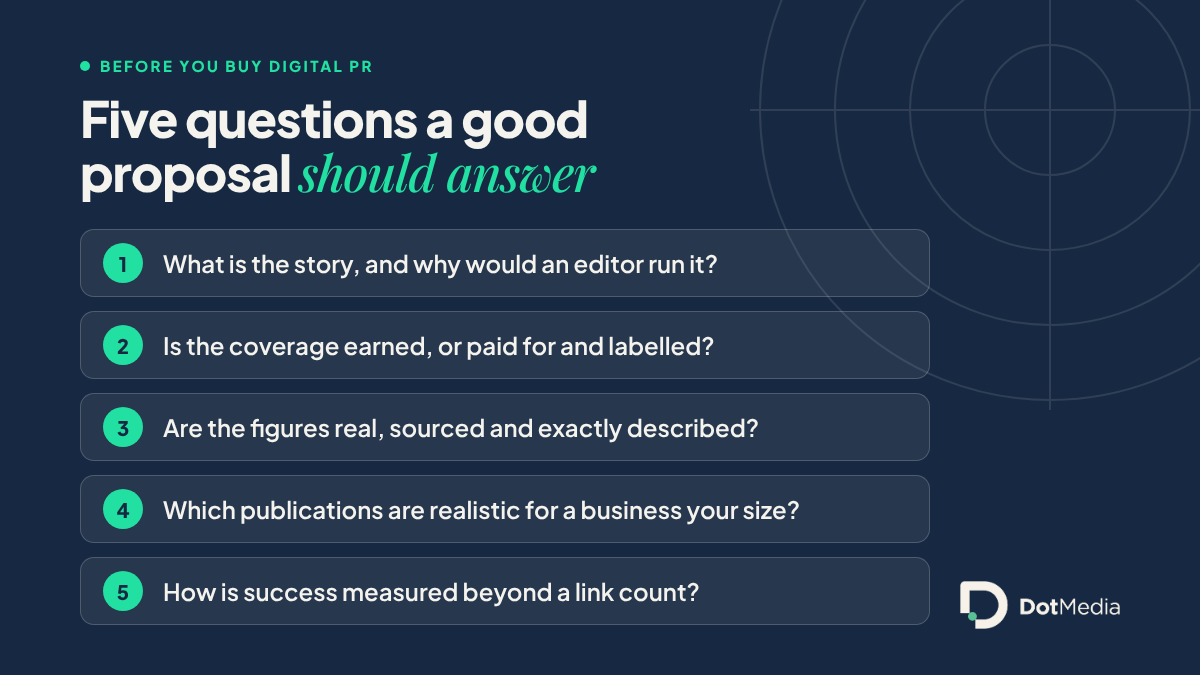
A good proposal answers those without hand-waving. A weak one leads with a list of big-name sites and a promised number of links.
Conclusion
Digital PR is earned coverage from online publishers, built on a story an editor actually wants to run. It matters more now because third-party mentions look like a meaningful ingredient in whether AI tools talk about your brand, although the evidence is correlation, mostly from Google AI Overviews, and not UK-specific. Keep it separate from paid placements, label anything that is paid, and judge any proposal by the story and the sourcing rather than by a promised link count.
FAQ
What is digital PR in simple terms?
It is the practice of earning mentions and links from online publications by giving them something worth publishing, such as expert comment, original data or a strong point of view.
Is digital PR the same as link building?
No. Link building starts with the link and works backwards. Digital PR starts with a story, and the links follow if the coverage is good. Paid links are a separate matter and carry labelling and link-tagging rules.
Does digital PR help you appear in ChatGPT and Google AI Overviews?
It may help, but nobody can promise it. The best public evidence is an Ahrefs study that found branded web mentions correlated with Google AI Overview visibility, and correlation is not proof of cause. It did not look at ChatGPT and is not UK-specific.
How long does digital PR take to work?
We do not know of a reliable, independently verified benchmark, and it depends on the story, the sector and the publications. Be wary of anyone who gives you a confident timeline.
Do I need to label digital PR coverage as an ad?
Not if it was genuinely earned and nobody paid for it. If you paid a publisher, or gave another benefit in return, UK guidance expects clear labelling, and links should be tagged rel=”sponsored” or nofollow for Google.
Ready to chat? Book a free 15-minute call and we’ll look at what is realistically worth earning coverage for in your sector, and what is not.