
If you run a small business, you already know the feeling. The phone rings while you are on a job, in a meeting or at the school gate, and by the time you call back the person has rung someone else.
An AI receptionist is the latest answer to that problem. The pitch is simple: it picks up every call, answers common questions, takes details and sometimes books the appointment. The reality is more mixed, and most of what you will read about it is written by the people selling it.
We have tried to write the version we would want to read ourselves. Here is what an AI receptionist does, what it costs in the UK, the data protection questions to ask, and when it is not worth the bother.
What is an AI receptionist?
An AI receptionist is software that answers your business phone using a synthetic voice, understands what the caller wants and responds in plain language. It is different from the old “press 1 for sales” phone menu, because the caller simply says what they need.
Most UK products work in one of two ways. Either callers reach the AI on your existing number when you do not pick up, or the AI answers every call first and passes the important ones on to you.
What it can do on the call
The listings we reviewed are fairly consistent. Fasthosts says its AI receptionist answers calls 24/7, forwards calls, emails you a summary after each call and, on higher plans, books appointments into Google Calendar or Outlook. RingCentral’s UK page describes call routing by name, location or keyword, lead capture with your own intake questions, and spam blocking.
In practice, that covers the dull but valuable jobs: opening hours, directions, “do you cover my postcode?”, taking a name and number, and passing urgent calls through.
What it cannot do
It cannot use judgement the way a good human receptionist can. It will not pick up that a caller sounds distressed, spot a regular customer’s tone or negotiate. It also only knows what you have told it, so a thin set of instructions gives you thin answers.
That is why we treat it as a safety net for calls you would otherwise miss, not a replacement for the people who know your customers.
Why are UK searches for AI receptionists climbing?
Interest is real. In September 2026, “ai receptionist” had about 1,300 UK searches a month, and “ai receptionist uk” about 390, according to keyword data from both OpenRush and Semrush (Google-derived estimates, not exact counts). Both tools also show demand rising over the past twelve months.
Take that with one caveat. The search results for these terms are dominated by the vendors themselves, plus a few comparison articles, some written by people with a commercial interest. When we looked at the page-one results on 3 November 2026, the top results were mostly providers such as GoTo Connect, Fasthosts, RingCentral and Moneypenny.
What about the “you lose X pounds a month in missed calls” claims?
You will see plenty. One comparison article we read quotes a vendor’s own figure of around three missed calls a week and roughly £540 a month in lost bookings for a typical service business, and the article’s own author runs that vendor. We could not find an independent, dated UK study to back figures like that, so we are not going to repeat them as fact.
The better approach is to measure your own. Check your phone log for a fortnight, count the missed calls, and multiply by what a typical enquiry is worth to you. That number is yours and it is honest.
How much does an AI receptionist cost in the UK?
Pricing falls into a few models, and the headline “from” price rarely tells you the real monthly bill. These are the ones you will meet.
| Pricing model | How you are charged | What to watch |
|---|---|---|
| Per call | A monthly fee with a set number of calls, then a charge per extra call. Fasthosts lists its entry plan from £39 a month for 30 calls, then 49p per extra call. | Spam calls and wrong numbers may count towards your allowance. |
| Per minute | A monthly fee with included minutes, then a per-minute rate. | Chatty callers and long calls push the bill up. |
| Flat or “unlimited” | One monthly price, usually with a fair-use limit. | Read the fair-use wording and check which features sit on which tier. |
The Fasthosts example is taken from its own listing and matches the figures in an October 2026 comparison on CXassist. Appointment booking sits on the next tier up (listed from £69 a month), which is a common pattern. Always check whether the price you are shown includes VAT, because the listings we read were not consistent on this.
The cheapest tier often cannot book appointments, which is usually the feature you actually want. Compare like with like before you decide.
What data protection checks should you make?
A phone call is personal data. Names, numbers and what people tell you about their problem all count. If an AI handles that, you are still the one responsible.
In January 2026 the Information Commissioner’s Office (ICO) published a “Tech Futures” report on agentic AI, meaning AI that takes actions on your behalf. It is not formal guidance, and an AI receptionist is at the simpler end of that spectrum, but it shows where the ICO’s thinking is heading. Summaries from techUK (13 January 2026) and law firm Burges Salmon (2 February 2026) pick out the same themes.
Be clear about who is responsible
Burges Salmon’s summary notes that AI systems do not have legal personality, so the organisation that deploys one stays responsible for UK GDPR compliance. If your AI receptionist makes a mess of someone’s details, “the software did it” is not a defence.
Tell callers what is happening
Transparency still applies. People should know they are speaking to an AI and what happens to what they say. A short line at the start of the call, and a clear privacy notice on your website, is a sensible minimum. Ask the provider whether calls are recorded and whether your data is used to train their models. Fasthosts, for example, states on its page that it does not record calls or train AI on your data, but you should confirm that for any product you choose.
Keep the data to what you need
Both summaries flag data minimisation. Set the AI up to collect only what it needs to follow up, such as a name, number and a one-line reason for the call. If your business takes calls where people might mention health or other sensitive details, think harder before handing those calls to an automated system.
None of this is legal advice. If you handle sensitive information, take proper advice and check the ICO’s own guidance.
A short checklist before you switch one on
We have boiled the above down to the questions that matter most. The panel below is worth saving.
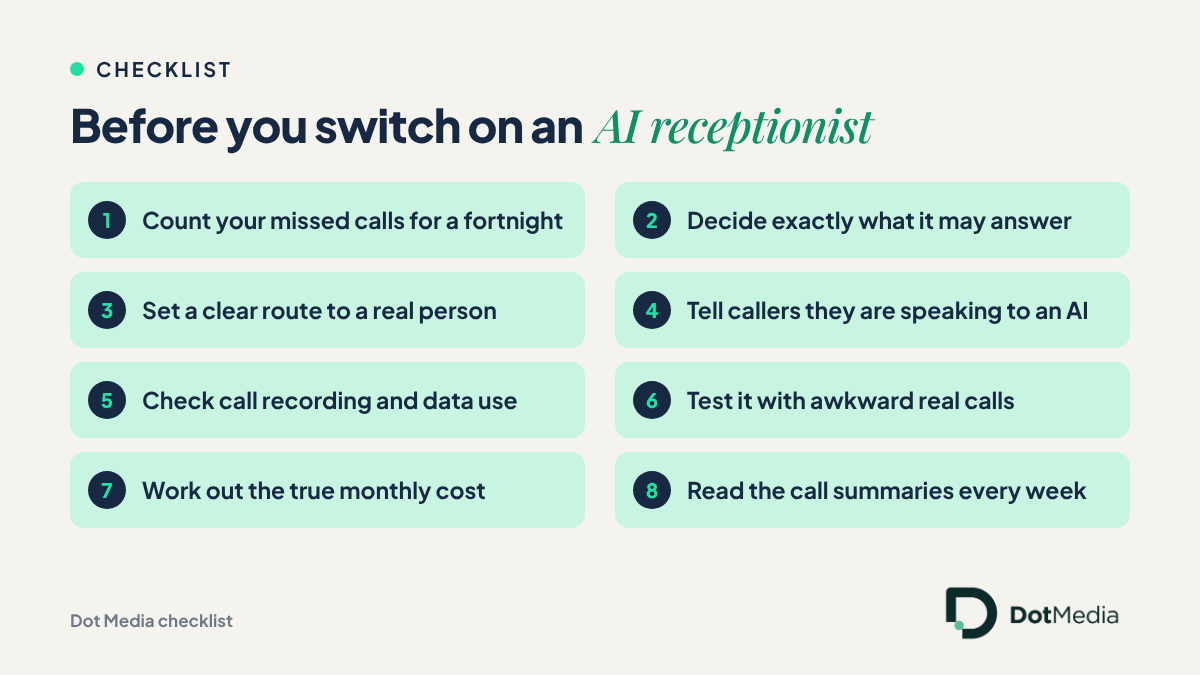
The last two matter most. Test it by ringing it yourself with awkward questions, and read the call summaries for the first few weeks. That is where you will find the wrong answers before a customer does.
If more of your new customers are also starting with AI assistants rather than search, it is worth making sure the AI can find and describe you accurately in the first place. We covered that shift in our post on AI shopping and what it means for UK online shops.
When is an AI receptionist not worth it?
It is probably not for you if you get only a handful of calls a week and already answer most of them. It is also a poor fit if your calls are mostly complex or emotional, where a human voice is the whole point.
It tends to earn its keep when calls arrive while your hands are full or you are closed: trades, clinics, salons, small professional firms and anyone who takes enquiries out of hours. Even then, start small. Run it for out-of-hours calls only, and widen it once you trust it.
Conclusion
An AI receptionist can be a useful safety net for the calls you would otherwise miss, as long as you go in with open eyes. Measure your own missed calls, compare real monthly costs rather than “from” prices, tell callers they are speaking to an AI, and keep a human route for anything that matters.
We have no case study of our own to quote here, and we would rather say so than invent one. What we can say is that the sensible way to adopt this kind of tool is small, tested and reviewed, not switched on and forgotten.
FAQ
What is an AI receptionist?
It is software that answers your business phone with a synthetic voice, understands what the caller says and responds. Typical jobs are answering common questions, taking messages, routing calls and booking appointments.
How much does an AI receptionist cost in the UK?
Entry plans are listed from around £39 a month at Fasthosts, which includes 30 calls and then charges 49p per extra call. Plans that book appointments cost more, and some providers charge by the minute. Check whether VAT is included.
Do I have to tell callers they are talking to an AI?
UK GDPR transparency rules still apply, and the ICO’s January 2026 thinking on agentic AI stresses that people should be told how their data is used. A short disclosure at the start of the call is a sensible approach. This is not legal advice, so check the ICO’s guidance for your situation.
Can an AI receptionist replace a human one?
For routine calls, it can take the pressure off. For complex, sensitive or high-value conversations, we would keep a human in the loop and set the AI to hand over.
Is it worth it for a very small business?
It depends on how many calls you miss and what each enquiry is worth. Count your missed calls for a fortnight first, then decide.
Ready to chat? Book a free 15-minute call and we’ll talk through where AI can help your business, and where it is not worth the effort.