
Google started rolling out its November 2026 core update on Tuesday 10 November. If your enquiries or traffic have wobbled this week, this is the likely reason, and the worst thing you can do right now is start rewriting your website in a panic.
What Google has actually announced
Google’s Search Status Dashboard logged the release at 10:06 Pacific time on 10 November and says it “applies globally and to all languages”. The rollout “may take up to 2 weeks to complete”. Search Engine Journal reports it is the third core update of 2026 and the eighth ranking update on the dashboard this year.
Google describes it as “a regular update designed to better surface relevant, satisfying content for searchers from all types of sites”. That is all it has said so far. There is no list of what changed and no blog post explaining the thinking, so anyone claiming to know exactly what this update rewards is guessing.
It is also not a UK-only change. Google says it applies worldwide, so the advice below is general rather than specific to British searchers.
How long will it take?
Two weeks is a guide, not a promise. The two earlier core updates this year both ran close to that figure, according to PPC Land and Search Engine Journal.
| 2026 core update | Rollout window | Length |
|---|---|---|
| March | 27 March to 8 April | 12 days, 4 hours |
| May | 21 May to 2 June | 11 days, 21 hours |
| November | From 10 November | Google says up to 2 weeks |
Sources: Search Engine Journal and PPC Land, November 2026. Durations are for each update’s rollout, not how long ranking effects last afterwards.
What to do this week
Wait, then compare like with like
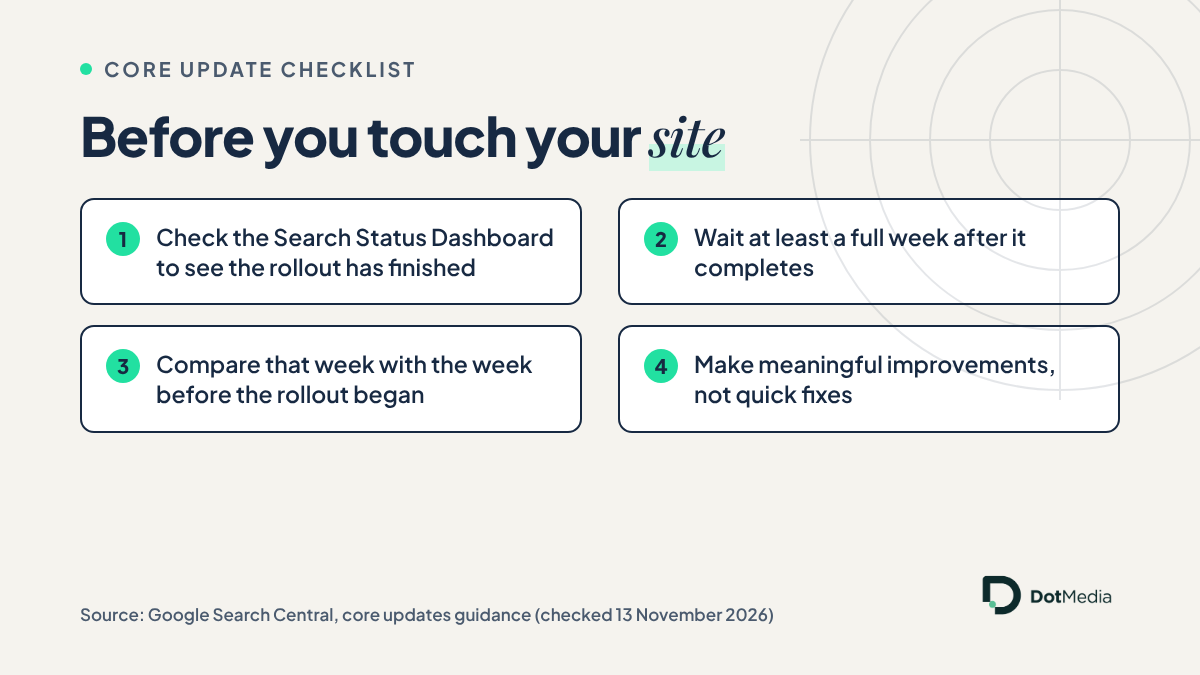
Google’s own core update guidance says to wait at least a full week after the update completes before analysing Search Console, then compare that week with the week before the rollout began. Looking at a graph on day three tells you very little, because rankings can move around during the rollout and settle later.
Check the size of any drop before reacting
Google says small position drops do not call for drastic action, and it advises against changing content that is already performing well. A drop on a handful of pages is a different problem from a sustained fall across the whole site. Only the second justifies a proper review.
Do not make quick fixes
The guidance specifically warns against quick fixes such as stripping out page elements because someone said they hurt SEO. It points instead to meaningful improvements, such as rewriting or restructuring content so it is easier for readers to use, and it treats deleting content as a last resort. This is the bit most small businesses get wrong, because the temptation in a bad week is to delete pages that took years to build.
Make a note of what you saw
Write down which pages and queries moved, and when. If it turns out to be a real, lasting change, that record is far more useful than a vague memory of “traffic dropped in November”.
What it means for your business
A core update is not a penalty. Google says these updates “don’t target specific sites or individual web pages” and are a reassessment of which pages best serve searchers. That framing matters, because it means there is usually no single thing to fix.
It also helps to remember that organic rankings are only one route to being found now. Google’s AI features are changing how many people click through at all, and we covered the gap in UK click data for AI Overviews recently. Third-party coverage on sites that search engines and AI tools already trust is another way to build visibility that does not hang on a single algorithm, which we explain in our plain guide to digital PR.
We have no original data on this update yet, and it would be wrong to pretend otherwise. We will know more once it finishes and the dust settles.
Conclusion
The November 2026 core update is live, it applies globally, and it may run until around 24 November. Do nothing dramatic until it has finished, wait a week, compare properly, and only then decide whether you have a real problem. If you do, improve the pages that matter to your customers rather than tearing the site apart.
FAQ
When did the November 2026 core update start?
It started on 10 November 2026, logged on Google’s Search Status Dashboard at 10:06 Pacific time. Google says the rollout may take up to two weeks.
Is this update UK specific?
No. Google says it applies globally and to all languages, so UK businesses are affected in the same way as everyone else.
Should I change my website now if rankings have dropped?
No. Google advises waiting until the rollout has finished, then waiting at least a further week before analysing Search Console data. Small drops do not need drastic action.
Is a core update a penalty?
Google says core updates do not target specific sites or pages. A drop reflects a reassessment of which pages best serve searchers, not a punishment.
How long does recovery take?
Google says some changes can show within days, but it could take several months for its systems to confirm lasting improvement, and there is no guarantee of a noticeable impact.
Ready to chat? Book a free 15-minute call and we’ll look at how your site is performing and whether this update is worth worrying about.